Overview
The name hoplomachus derives from the Greek words hopla ("weapons", "heavy armament") and makhē ("fight, battle") — meaning "one who fights in armour". The name itself already points to the Hellenic military model: the type adapts the pattern of Hellenistic hoplites and the Macedonian–Greek phalanx to the logic of the Roman arena.
The type appears at the end of the 1st century BC, from the Augustan age, and is attested throughout the imperial period (1st–3rd century AD). Several scholars (including Junkelmann) interpret the pairing against the Murmillo as a symbolic re-enactment of Rome's eastern, Hellenistic wars.
Historical accuracy and our shows
With his armament recalling Hellenistic hoplites, the hoplomachus was an established, classic type of the post-Augustan arena world of the 1st–2nd century AD — the natural opponent of the murmillo. Our shows evoke this entire 1st–2nd-century period: long spear (hasta), small round shield (parma), backup short sword (gladius or pugio), a pair of tall ocreae, a manica on the sword arm, and a crested helmet with two plume holders.
Differences across periods: the type is stable — from the early imperial period (1st century AD) to the 3rd century, the basic equipment remains almost unchanged. Minor variations appear in helmet decoration and the shape of the plume holders; the Greek-inspired character (the parma and the long spear) persists throughout. The 2nd-century visual sources (Bad Kreuznach, the Lugdunum mosaic) are direct contemporary depictions for the period of our shows.
Images
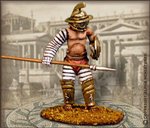


The images hosted on gladiator.hu were collected by the association; the images linked from Wikimedia Commons are photographs of ancient archaeological artefacts in the public domain or under free licences.
Weapons and equipment
- Hasta — long thrusting spear, the main weapon. Martial (5.24) portrays the arena fighter as a figure fighting with a spear.
- Short blade (gladius or pugio/dagger) — close-combat secondary weapon, for after the spear was thrown or lost. According to reconstructions and depictions, the hoplomachus often gripped this short blade in the left hand, together with the small shield, while holding the spear in the right hand — the assignment of hands, however, is an iconographic reconstruction (see Disputed elements).
- Small round bronze shield — most often referred to as a parmula; some sources describe it as a smaller clipeus (the precise distinction between the two terms is disputed).
- Two tall ocreae — worn on both legs because of the small shield, often reaching mid-thigh.
- Manica — an arm guard of textile or metal strips worn on the (right) sword arm.
- Broad-brimmed, crested helmet — with plumes on top and a feather on each side; the Pompeian depictions and the Zliten mosaic show it this way.
Typical opponent
The most common pairing is against the Murmillo (Zliten mosaic, Pompeian depictions). A pairing against the Thraex is also attested — according to Suetonius (Caligula 35), Caligula pitted these types against each other. Several scholars interpret the hoplomachus–murmillo encounter as a symbolic clash of Greek and Roman styles of armament.
Ancient literary mentions
- Suetonius, Vita Caligulae 35.2 — Caligula pits thraeces and hoplomachi against each other.
- Martial, Epigrammata 5.24 and 8.74 — a hoplomachus fighting with a spear.
- CIL and funerary inscriptions — the hoplomachus as an armatura (armament category).
Archaeological and visual sources
- Pompeian frescoes and graffiti (before AD 79) — with inscribed labels.
- Zliten mosaic (Libya, Villa Dar Buk Ammera, ca. late 1st – early 2nd century AD) — explicit hoplomachus–murmillo scene.
- Bronze hoplomachus statuette in fighting stance — Berlin, Antikensammlung, Staatliche Museen zu Berlin, inv. no. 1958.4 (2nd century AD). Crested, broad-brimmed helmet, manica on the right arm, small round shield in the left hand, and a long, straight, pointed shaft in the right hand (the form of the weapon is not unambiguously a classic hasta). This is the figure shown in the gallery above, often shared under the label "Neues Museum, Berlin". Official record: museum-digital.de.
- Tombstones and reliefs in Italy and the eastern Mediterranean (e.g. Smyrna, the area of Ephesus).
Disputed elements
- The exact type of the shield (parmula or a small clipeus); its size and material are reconstructed.
- The left-handed grip of the short blade (dagger or short sword) together with the shield is a common iconographic reconstruction, but no primary ancient text records the assignment of hands; the scholarly literature mentions the blade as a secondary weapon, without specifying the hand.
- Junkelmann's hypothesis of a steel-tube arm guard is not universally accepted.
- The distinction between the thraex and the hoplomachus is uncertain, because the helmet and greave types can overlap; some depictions can only be told apart by the shield (round or angular) and the weapon.
Sources
- Britannica, "Hoplomachus": britannica.com
- Encyclopaedia Romana (J. Grout): penelope.uchicago.edu
- Smith's Dictionary, "Gladiatores" (LacusCurtius): penelope.uchicago.edu
- Junkelmann, Marcus: Das Spiel mit dem Tod. Mainz: Philipp von Zabern, 2000.
- Meijer, Fik: The Gladiators. Thomas Dunne Books, 2005.
- Suetonius, Caligula 35.2 (Loeb).
- Martial, Epigrammata 5.24 and 8.74 (Loeb).
- Antikensammlung, Staatliche Museen zu Berlin — bronze hoplomachus statuette, inv. no. 1958.4 (museum-digital): museum-digital.de (official photo: Ingrid Geske, CC BY-NC-SA).