Overview
The secutor — literally "pursuer", from the verb sequor — emerged specifically as the opponent of the retiarius, around AD 50. Earlier scholarship placed the type in the Augustan age, but the more recent archaeological and iconographic analyses of Junkelmann and Ville date it to the early imperial period (Claudius–Nero). Its heyday was the 2nd–3rd centuries.
The duel of the secutor and the retiarius was one of the arena's most popular spectacles. According to Isidore's later interpretation the retiarius symbolised Neptune and the secutor Vulcan — placing the duel in a cosmic, mythological frame.
Historical accuracy and our shows
The secutor is the natural counterpart of the retiarius, and one of the most spectacular figures of the post-Augustan arena world of the 1st–2nd centuries AD. The type takes shape in the early-to-mid 1st century AD (the Julio-Claudian age) as a specialised form against the net — a smooth, streamlined helmet with small round eye-holes that the net cannot snag on. From the Flavian to the Severan age it is fully established. Our shows evoke this whole 1st–2nd-century period; we present the secutor in its classic form: the distinctive "secutor helmet", scutum, gladius, manica on the right arm, short ocrea on the left leg.
Differences between periods: between the 1st and 3rd centuries the type lives on with a relatively stable silhouette. The bronze secutor helmets from Pompeii (AD 79) are the reference points for the Julio-Claudian and Flavian base form. From the mid-2nd century the helmets largely become hinged (opening into two halves) and the decoration grows richer. The Bad Kreuznach mosaic (c. AD 240) is a direct descendant of our period.
Images
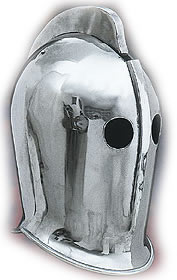
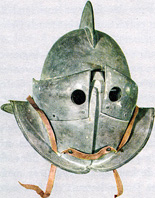
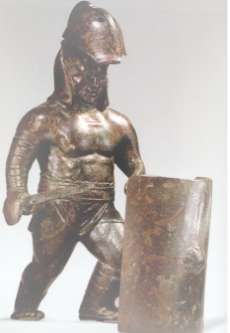
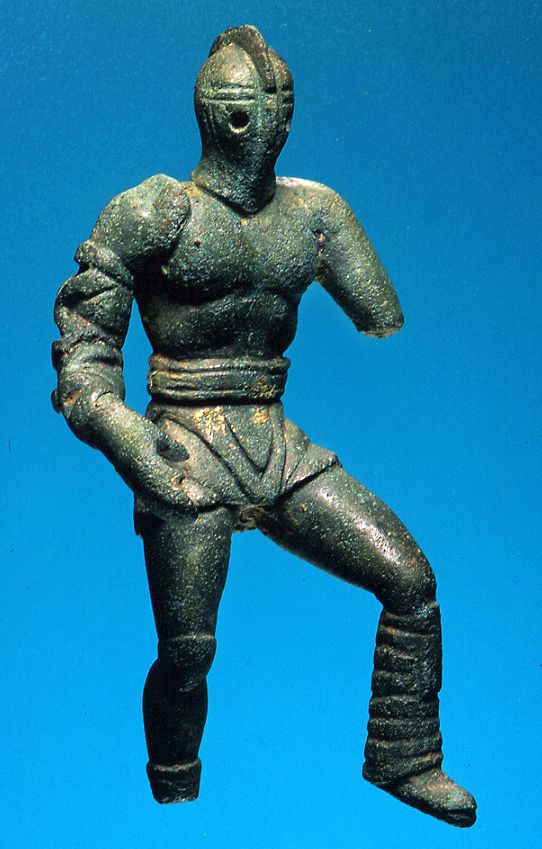
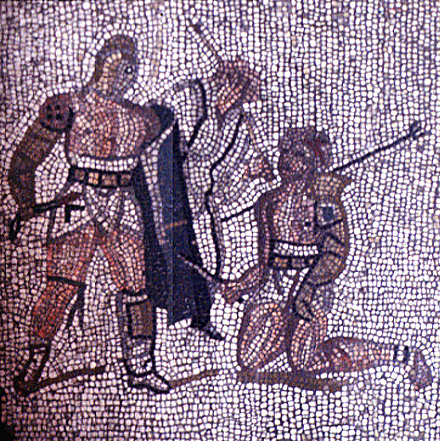
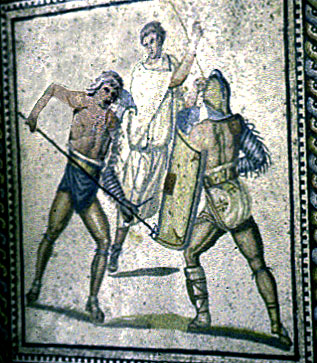
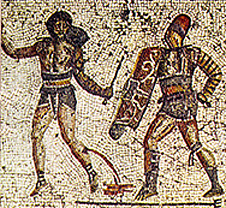
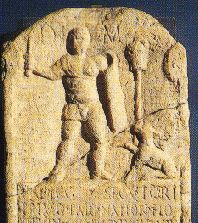
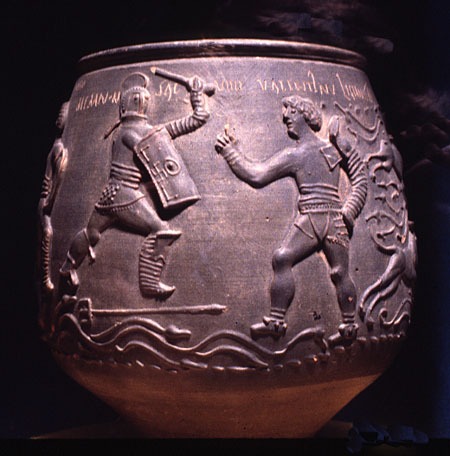


The images hosted on gladiator.hu were collected by the association; the images linked from Wikimedia Commons are photographs of ancient archaeological monuments in the public domain or under free licences. The Sketchfab 3D models are official publications by the source institutions (Musée départemental Arles antique; Politecnico di Milano CVRE Lab — Antiquarium "Alda Levi", Milan), embedded via the interface they provide.
Weapons and equipment
- Gladius — short, double-edged Roman sword. On some depictions a pugio dagger also appears.
- Helmet (galea) — the hallmark of the type. Smooth, round-topped, streamlined form with two small (c. 4–5 cm) circular eye-holes — precisely so that the retiarius's net and trident cannot snag on it. The neck-guard scaling has a smooth, fish-like line. A classic example is in the Naples National Archaeological Museum (inv. 5642), from the Caserma dei Gladiatori at Pompeii.
- Manica — a metal-scale or leather-strip arm guard on the right arm.
- Ocrea — a single greave on the left leg.
- Scutum — large, curved, rectangular shield (legionary type).
An important constraint: according to Junkelmann's experimental reconstructions, because of the closed, heavy helmet the secutor had to win quickly — he was exhausted after about 10–15 minutes. This explains the combat dynamics of the type: rapid attack, determined pursuit.
Emperor Commodus as a secutor
Emperor Commodus fought publicly as a secutor, which his contemporaries considered especially scandalous for a ruler. According to Cassius Dio (Roman History 73 [72], 17–22) he took to the arena floor several hundred times; a wooden sword in his left hand, a shield in his right — he was proud of his left-handedness. The Historia Augusta (Vita Commodi 11–12, 15) mentions 735 appearances. He was murdered on the night of 31 December 192, before he could appear again as a secutor at the Ludi the next day.
Archaeological and visual sources
- Zliten mosaic (Libya, Archaeological Museum of Tripoli, c. early 2nd c. AD) — several secutor–retiarius duels.
- Kalendio and Astyanax mosaic (Madrid, Museo Arqueológico Nacional, 3rd century) — a secutor labelled by inscription (Astyanax) wins over the retiarius Kalendio.
- Pompeii frescoes from the Caserma dei Gladiatori (VIII.7.16) and the secutor helmet (Naples, MANN, inv. 5642).
- Nennig mosaic (Germany, c. 240–250).
Ancient literary mentions
- Suetonius, Divus Claudius 34.1 — Claudius is curious how secutores die with their faces uncovered.
- Cassius Dio 73 (72), 17–22 — Commodus's appearances as a secutor.
- Historia Augusta, Commodus 11–12, 15.
- Isidore, Etymologiae XVIII.54–55 — the etymology of the name.
Disputed elements
- The exact time the type appeared (the Augustan age or the Claudian–Neronian age).
- The relationship of the secutor and the contraretiarius: synonyms or a transitional form.
- The dating of the Zliten mosaic (Ville: c. 80–120; Parrish: c. 200).
Sources
- Cassius Dio, Roman History 73 — Penelope/U. Chicago: penelope.uchicago.edu
- Historia Augusta, Vita Commodi: penelope.uchicago.edu
- Encyclopaedia Romana, "Secutor": penelope.uchicago.edu
- Encyclopaedia Romana, "The Helmet of the Secutor": penelope.uchicago.edu
- Junkelmann, Marcus: Gladiatoren: Das Spiel mit dem Tod. Mainz: Philipp von Zabern, 2008.
- Meijer, Fik: The Gladiators. St. Martin's Press, 2005.
- British Museum, gladiator helmet (G_1946-0514-1): britishmuseum.org