Overview
The retiarius — literally the "net man", from the word rete — is one of the latest gladiator types to appear. Both iconographically and in literature it surfaces during the 1st century AD, and it already features under the Julio-Claudian dynasty (Suetonius); its heyday is the 2nd–3rd centuries, when the retiarius depictions of the Zliten and Nennig mosaics were made.
He fought without a helmet and without a large shield, in light equipment: net, trident, dagger. He relied on mobility, keeping the distance and an accurate net throw. This seemingly unarmed yet highly specialised technique made the retiarius one of the most exciting spectacles of the arena — and at the same time one of the lowest-status gladiators.
Historical accuracy and our shows
The retiarius is one of the most characteristic gladiator types of the post-Augustan early and high imperial period. Its origin goes back to the Julio-Claudian age (the first half of the 1st century AD) — Suetonius (Caligula 30.3) mentions the type — and from the Flavian to the Severan age the retiarius–secutor duel was the most spectacular event of the arena. Our shows evoke the Roman arena world of the 1st–2nd centuries AD; we present the retiarius in its classic, tunic-less form: without a helmet, with a galerus on the left shoulder, a manica on the left arm, a net (rete) and a three-pronged trident (tridens), and a supplementary pugio.
Changes across the periods — important!
- Republican era: the type did not exist — it is clearly an imperial-era innovation.
- Early 1st century AD (Julio-Claudian age): the type appears, still counting as a novelty at this point. Suetonius mentions several scenes.
- Late 1st century – 2nd century AD (Flavian and Antonine age): the classic form stabilises; this is the main reference for our shows.
- 2nd–3rd centuries AD: retiarius tunicatus — some fighters wore a short-sleeved tunic. According to Juvenal and Suetonius this was a shameful variant (a mark of infamia). We deliberately do not use this variant in our shows — we put the classic, dignified retiarius on stage; we refer to the tunicatus at most in a character story.
Images
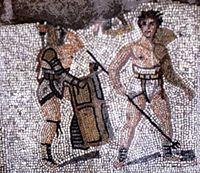
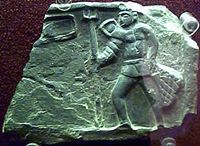
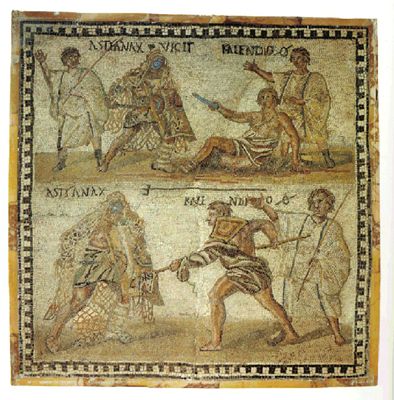
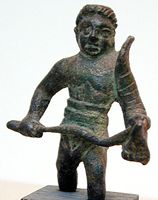
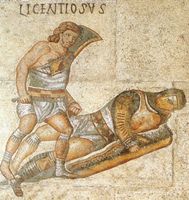
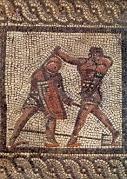


The images hosted on gladiator.hu were collected by the association; the images linked from Wikimedia Commons are photographs of ancient archaeological monuments in the public domain or under free licences.
Weapons and equipment
- Rete — a round throwing net c. 3 m in diameter, weighted with lead, attached to the wrist. Based on the depiction on the Rheinzabern terra sigillata jug, it was cast from below.
- Fuscina / tridens — a man-height trident, for thrusting and keeping the distance. Fuscina is the more common Latin name.
- Pugio — a reserve dagger for close combat; on a tombstone from Romania and on a bone find from Ephesus a four-pronged quadrens also appears.
- Galerus — a bronze or leather shoulder guard on the left shoulder, c. 30–35 cm, with a rim that widens upward. It shielded the head and face like a small shield in the fighting stance turned to the left side.
- Manica — a textile/leather/metal-scale arm guard drawn over the left arm.
- Balteus and subligaculum.
- He fought without a helmet — a unique feature among the gladiator types.
Typical opponent and combat dynamics
The primary opponent of the retiarius was the Secutor, which was developed specifically against the net fighter: a smooth, fish-like helmet with two tiny eye holes, so that the point of the trident could not catch on it. The encounter of the two types was one of the most frequent and most dramatic duels of the arena. More rarely he could also take the field against a Murmillo.
Social standing
The retiarius belonged to the lower-status types — the absence of a helmet and a large shield lent little "military" dignity. Gladiators generally stood under infamia (the "dishonoured" status of Roman law), and the retiarius tunicatus (the sub-variant fighting in a tunic) was even more degrading — Juvenal repeatedly attacks Gracchus, the scion of an ancient noble family, who performs in this role.
Ancient literary mentions
- Suetonius, Caligula 30.3 — Caligula had five tunic-wearing retiarii fight against a group of secutores.
- Juvenal, Saturae II.143 ff. — Gracchus, a man of ancient noble family, performs as a retiarius, in a tunic.
- Juvenal, Saturae VIII.199 ff. — the same Gracchus botches the net throw.
- Juvenal, Saturae VI.O.7–13 (the "Oxford fragment") — the humiliation of the retiarii tunicati in the ludus.
- Seneca, Naturales Quaestiones VII.31.3 — refers to the "unclean section" of the ludus.
- Cassius Dio, Epitome 73 (Xiphilinus) — an indirect retiarius context for Commodus's secutor performances.
Archaeological and visual sources
- Zliten mosaic (Libya, Archaeological Museum of Tripoli) — several retiarius–secutor duels.
- Nennig mosaic (Germany, c. AD 240–250).
- The Ludus at Pompeii — three inscribed or decorated galeri, one of them with the inscription "RET/SECUND" ("retiarius secundus", second rank).
- Gladiator cemetery at Ephesus — wounds from a trident on skull and skeleton (the osteoarchaeological analyses of Großschmidt and Kanz).
- Fortis stele — a marble altar stele with the inscription "ΦΟΡΤΙϹ", depicting a retiarius.
- Rheinzabern jug (terra sigillata) — the technique of the net throw.
- Chester (Deva Victrix) retiarius relief — a provincial tombstone, Grosvenor Museum, Chester.
- Astyanax–Kalendio mosaic (Madrid, Museo Arqueológico Nacional, 3rd century) — the victorious secutor and the defeated retiarius; beside Kalendio's name the theta nigrum (Θ, an abbreviation of thanatos) marks the death.
Disputed elements
- It is disputed whether the retiarius tunicatus was an independent sub-class or merely a satirical exaggeration (Cerutti–Richardson 1989, and other interpretations).
- The fastening of the net to the wrist with a cord is partly a reconstruction (Junkelmann).
Sources
- Britannica, "Retiarius": britannica.com
- Encyclopaedia Romana (J. Grout), "Retiarius and the retiarius tunicatus": penelope.uchicago.edu
- Juvenal, Saturae — Latin Library: thelatinlibrary.com
- Suetonius, Caligula 30 — Penelope/U. Chicago: penelope.uchicago.edu
- Cassius Dio, Epitome 73: penelope.uchicago.edu
- Junkelmann, Marcus: Das Spiel mit dem Tod. Mainz: Philipp von Zabern, 2000.
- Köhne, E. – Ewigleben, C. (eds.): Gladiators and Caesars. London: British Museum Press, 2000.
- Cerutti, S. – Richardson, L.: "The Retiarius Tunicatus", AJP 110/4 (1989), 589–594.