Overview
The veles (plural: velites) was originally the light, javelin-throwing infantry of the Republican-era Roman army. As a military category it is well attested; as an arena gladiator type, however, its existence is disputed. No clear ancient depiction or physical find relating to a distinct veles weapon class is known.
Historical accuracy and our shows
As a distinct gladiator type the veles is of disputed existence, and in terms of historical accuracy it is difficult to fit into the arena world of the post-Augustan 1st–2nd centuries AD. The existence of the velites light infantry serving in the Republican-era Roman army is certain, but that is a military, not a gladiatorial category. The distinct veles gladiator type is referred to by Aequinox, citing a "doctor velitum" inscription — the exact identification of which (a CIL or AE number) requires further verification. No other gravestone, mosaic, fresco, helmet or weapon find can be linked unambiguously to a veles gladiator either, whether within our 1st–2nd century period or outside it.
In our shows (1st–2nd centuries AD) the regular presence of the veles cannot be established historically. If it does appear, we always clearly mark the uncertainty of the reconstruction; the equipment (spear, manica, absence of a helmet) is a logical assumption, not based on any archaeological find. It may be mentioned as a reference in character stories, but featuring the type in an arena scene — especially in a leading role — would run counter to our principles of historical accuracy.
Images
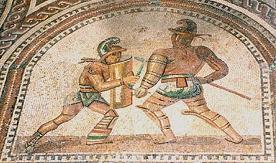
No direct, unambiguous ancient depiction of this type is known. The image above too rests only on conjecture: the identification is disputed.
What is certain and what is not
- Certain: the velites, that is, the light infantry armed with spears, existed in the Republican-era Roman army. This, however, is a military, not a gladiatorial category.
- Uncertain / source needed: Aequinox (Collegium Gladiatorium, 2005) refers to a "doctor velitum" inscription — that is, to a gladiator trainer who trained velites-type fighters. If it can be authenticated, this is indirect evidence for the distinct type. The exact identification of the inscription (a CIL or AE number) requires verification.
- Not confirmed: apart from the inscription, no gravestone, mosaic, fresco, helmet or weapon find can be linked unambiguously to a veles gladiator.
Possible equipment (reconstruction)
- Hasta — a thrusting spear 1.8–3 m long.
- Manica on the weapon-wielding arm (reconstructed).
- Without a helmet — a logical assumption based on the light, agile style of fighting.
- Probably no shield, or a small oval one — the latter's pictorial depiction contradicts the rule that two identical types did not normally fight each other.
These items are not based on any archaeological find — according to Aequinox's analysis the veles may have been a light weapon class of versatile technique, one that made up for the lack of armour with agility.
Possible connections with other types
- A similar combat role was filled by the retiarius and the early (spear-armed) hoplomachus — the Republican-era, Hellenistic-style hoplomachus fought with a spear before it turned, by the imperial period, into a large-shielded weapon class.
- The late (mounted, spear-armed) variant of the eques is also raised in some depictions — but these do not point to veles-type infantry.
- Some mosaics and frescoes show fighters battling without a helmet, with a small oval shield and a spear. Linking these to the veles type is not proven; these descriptions can often be referred rather to a hoplomachus who has lost his shield.
Possible eastern or exotic context
In the arenas of the eastern provinces the rules and equipment were less uniform than in the west (Carter 2006). In this setting it is conceivable that spear-armed fighters occasionally appeared. Nubian or other "exotic" fighters brought into the arena as part of the spectacula may even have carried a spear as their original weapon, but this counted rather as an exhibitio-type spectacle, not as a distinct gladiatorial weapon class.
Disputed elements
- Whether the veles existed at all as a distinct armatura in the imperial-era arena.
- The identification of the "doctor velitum" inscription (CIL/AE).
- Some of the "small oval shield + spear + no helmet" depictions probably show a hoplomachus who has lost his shield.
- Part of the modern weapon-class lists rests rather on reconstruction, or on late-medieval or early-modern interpretation; the ancient sources are rare and indirect.
Sources
- Junkelmann, Marcus: Gladiatoren. Das Spiel mit dem Tod. Mainz: Philipp von Zabern, 2008.
- Meijer, Fik: The Gladiators. Thomas Dunne Books, 2005.
- Carter, Michael J.: "Gladiatorial Combat: The Rules of Engagement", Classical Journal 102.2 (2006), 97–114.
- Köhne, E. – Ewigleben, C. (eds.): Gladiators and Caesars. London: British Museum Press, 2000.
- "Doctor velitum" inscription — exact identification (CIL/AE): source needed.