Overview
The murmillo was one of the classic "heavy" gladiator types of the Roman arena: he entered the sand with a large, curved rectangular shield, a short sword and a distinctive fish-shaped crested helmet. The type took its settled form in the early imperial period, under the reign of Augustus — it is usually interpreted as a renamed version of the earlier gallus type, after the Gallic peoples had become Romanised and it grew politically awkward to portray them as enemies.
Cicero already mentions the word myrmillo in the Philippicae, written in 44–43 BC, so the name was in use at the end of the Republic. Its popularity peaked in the 1st–3rd centuries AD. Festus preserved the explanation of the name: the word derives from the Greek fish name μορμύρος, referring to the fish-like crest of the helmet.
Historical accuracy and our shows
The murmillo was one of the central gladiator types of the early and high imperial arena (the post-Augustan 1st–2nd centuries AD) — the classic "heavy vs. light" pairings (murmillo–thraex, murmillo–hoplomachus) remained headline attractions throughout this 200-year period. Our shows evoke this broad era — from the death of Augustus (AD 14) to roughly AD 200, so we present the classic murmillo form in full equipment: fish-shaped crested helmet with grilled visor, scutum, gladius, manica on the right arm, short greave on the left leg.
Differences between periods: the Republican-era forerunner (the gallus) was renamed in the Augustan age; some elements of the equipment (shield, helmet form) live on as a direct inheritance. The bronze examples from Pompeii (pre-AD 79) are the reference points for the classic Julio-Claudian and Flavian form. By the end of the 2nd century (the Antonine age) helmet decoration grows richer (Hercules medallions, ornate engraving), but the basic structure remains stable — the Bad Kreuznach (c. AD 240) and Zliten (c. AD 200) mosaics show the same silhouette as the Pompeii examples.
Images
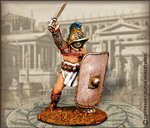


The images hosted on gladiator.hu were collected by the association; the images linked from Wikimedia Commons are photographs of ancient archaeological monuments in the public domain or under free licences. The Sketchfab 3D model is an official publication by the source museum (The British Museum), embedded via the interface they provide.
Weapons and equipment
- Gladius — short, double-edged, straight Roman sword, c. 64–81 cm, for thrusting and cutting (legionary type).
- Helmet (galea) — broad-brimmed, with a grilled visor and a tall fish-shaped crest, often with a plume. A classic example is in the British Museum (inv. 1946,0514.1, from the Caserma dei Gladiatori at Pompeii).
- Manica — segmented or scale arm guard on the right arm.
- Ocrea — a single short greave on the left leg.
- Scutum — large, curved, rectangular legionary shield (reconstructed size c. 100–105 cm, after Junkelmann).
- Subligaculum (loincloth) and balteus (broad leather belt).
Typical opponent
The murmillo was usually matched against the small-shielded, Greek- or Thracian-inspired types: most often the Thraex or the Hoplomachus. This pairing served both visual contrast and the "Roman vs. foreigner" symbolism. According to Quintilian (Inst. Or. VI.3.61) the pairing against the Retiarius also occurred, but more rarely — the retiarius's dedicated opponent was the Secutor.
Ancient literary mentions
- Cicero, Philippicae II.63 and III.31 — mocks Lucius Antonius, who fought as a myrmillo at Mylasa.
- Festus / Paulus ex Festo 359 L — explains the origin of the word murmillo, connecting it with the fish helmet.
- Quintilian, Institutio Oratoria VI.3.61 — murmillo–retiarius pairing.
Archaeological and visual sources
- Gladiator barracks at Pompeii (Quadriportico dei Teatri, Reg. VIII) — several bronze helmets.
- Naples National Archaeological Museum (MANN) — gladiator helmets from Pompeii with ornate relief decoration.
- Zliten mosaic (Libya, c. 2nd c. AD, Archaeological Museum of Tripoli) — thraex–murmillo and hoplomachus–murmillo duels.
- Funerary monument of Quintus Sossius Albus (Aquileia, AD 100–125, limestone, Museo Archeologico Nazionale di Aquileia, Lupa.at no. 17539) — one of the earliest gladiator funerary monuments known by name; the inscription (myrmillonis) gives an explicit type designation, and the relief records the helmet, gladius, scutum, manica, greave and the subligaculum all at once.
A murmillo known by name: Quintus Sossius Albus
The funerary monument from Aquileia (AD 100–125, the Trajanic–Hadrianic era) preserves the memory of a specific murmillo. The Latin inscription:
D(is) M(anibus) // Q(uinti) Sossi / Albi / myrmillonis / Sossia Iusta / lib(erta) patron(o) / bene merenti
"To the Divine Manes. In memory of Quintus Sossius Albus, murmillo. Sossia Iusta, [his] freedwoman, to her well-deserving patron."
The inscription records three important pieces of information. First, the tria nomina (Quintus Sossius Albus) indicates that he was a free Roman citizen — presumably an auctoratus, that is, a volunteer contract gladiator who entered the arena by his own decision (slave gladiators usually appear on inscriptions with only a single nickname). Second, the dedicator Sossia Iusta bears the same gens name as Albus: she had previously been Albus's slave, whom he manumitted — Albus remained her patron even after her manumission. Third, with the form myrmillonis the inscription itself confirms that the type's Latin name was a technical term in use in the imperial period.
The monument came to light in 1977–78 in Aquileia, beside the via Annia, east of Ponte Rosso. It is made of limestone, measuring 47 × 98 × 15 cm. It is currently kept in the storerooms of the Museo Archeologico Nazionale di Aquileia (not on permanent display). Record: Lupa.at no. 17539.
Disputed or uncertain elements
- The process of the gallus → murmillo renaming is only an indirect reconstruction.
- The exact size and weight of the shield are known from analogical experimental reconstruction (Junkelmann).
- It is not certain that the "fish helmet" was uniform for every murmillo — on some Pompeii examples a Hercules medallion appears instead.
- The explicit name murmillo has not been confirmed in Suetonius, Cassius Dio, Juvenal, Martial, Seneca or Tacitus — further textual verification is needed.
Sources
- British Museum — Bronze gladiator helmet, Pompeii (G_1946-0514-1): britishmuseum.org
- Encyclopaedia Romana (J. Grout, U. of Chicago), "Murmillo": penelope.uchicago.edu
- Metropolitan Museum of Art, "Gladiators: Types and Training": metmuseum.org
- Parco archeologico del Colosseo, "Gladiators in the Arena": colosseo.it
- Cicero, Philippicae II.63 — Perseus Digital Library: perseus.tufts.edu
- Junkelmann, Marcus: Das Spiel mit dem Tod. So kämpften Roms Gladiatoren. Mainz: Philipp von Zabern, 2000.
- Meijer, Fik: The Gladiators: History's Most Deadly Sport. Thomas Dunne Books, 2005.
- Zliten mosaic overview — Livius.org: livius.org
- Funerary monument of Quintus Sossius Albus (Aquileia) — Lupa.at record (Universität Salzburg / Ubi Erat Lupa): lupa.at/17539 · EDR007179 · EDCS-29900232 · AE 2003, 680.
- V. M. Hope: Constructing Identity: The Roman Funerary Monuments of Aquileia, Mainz and Nimes, Oxford 2001, 145.
- Giulia Lettich: Itinerari Epigrafici Aquileiesi, Trieste 2003, no. 133.