Overview
The provocator ("challenger", "provoker") is a type attested from the mid-1st century BC (the late Republic) to the early 3rd century AD. Its earliest secure mention is found in Cicero's speech Pro Sestio (chapter 134, 56 BC) — it is worth noting that this is not the In Verrem, which speaks only of a gladiatorial banquet.
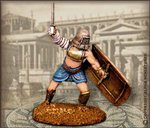
The type's unique feature is the breastplate (cardiophylax or pectorale) — no other gladiator type wore it. This piece of equipment turned the duel into a kind of miniature legionary combat in the arena: they fought in similarly equipped, mirror-like pairs.
Historical accuracy and our shows
The provocator's duel, pitting two identical types against each other, was one of the most technical and spectacular productions of the post-Augustan 1st–2nd century AD arena. It is a type attested from the Republican era and surviving throughout the entire imperial period. Our shows evoke this broad 1st–2nd century period, so we can use both dominant sub-forms of the type, depending on whether the performance evokes the Julio-Claudian or Flavian age, or the Antonine or early Severan age.
Differences between periods — the form of the helmet and the cardiophylax changes over time:
- Republican era: a simpler, crestless helmet and a rectangular breastplate. We do not present it — it falls outside the period of our shows.
- 1st century AD (Julio-Claudian and Flavian age): a classic Pompeian-style, close-fitting helmet with a grilled visor and two plumes, and a rectangular or slightly curved cardiophylax breastplate. The Pompeian bronze examples in the Naples National Archaeological Museum (MANN) are the reference point.
- Mid- to late 2nd century AD (Antonine age): the cardiophylax gradually becomes crescent-shaped (lunula), the helmet is more richly decorated, and a single crest often takes the place of the plumes.
The basic equipment (medium curved scutum, gladius, manica on the forearm, a long greave on one leg) remains the same throughout. The difference is given mainly by the details of the helmet and the outline of the cardiophylax.
Images


A direct Wikimedia photograph of the Anicetus tombstone (CIL VI 10183) is still being sought.
Weapons and equipment
- Gladius — a short, straight-bladed, leaf-shaped thrusting sword. Exceptionally a spatha is also attested (tombstone of Anicetus, CIL VI 10183).
- Scutum — a medium-sized, curved, rectangular shield (smaller than the legionary's).
- Cardiophylax / pectorale — the breastplate, the provocator's only distinguishing feature. The early pieces are rectangular; later the crescent-shaped (lunula) ones become more common. It covers only the central part of the torso, so that the arms retain their range of movement.
- Manica on the forearm.
- Ocrea on a single leg (typically the left), the long variety reaching above the knee.
- Helmet — a grilled, close-fitting galea. For details, see below.
Helmet variation by period
- Augustan age (c. 27 BC – AD 14): a form of legionary origin, with a crest and a broad brim.
- Neronian age (AD 54–68): the crest and brim disappear, the helmet becomes rounded, and tall penna plumes appear on either side.
- Flavian age (AD 69–96): the round, pierced, grilled, twin-plumed arena helmet takes its settled form. The original Pompeian provocator helmet in Naples (MN inv. 5670) represents this type.
Typical opponent
The provocator fought exclusively against another provocator — this is a rule confirmed by the visual sources, since he is depicted only in pairs of the same type. On some eastern reliefs a different pairing occurs (with a murmillo or thraex), but these are regarded as exceptional and disputed. This mirror-like duel is unique among the gladiator types.
Ancient literary mentions
- Cicero, Pro Sestio 134 (56 BC) — an organiser casts lots to assign slaves to the roles of Samnis and provocator. The earliest textual mention of the type.
- Petronius, Satyricon 45 (a conversation put into Echion's mouth at Trimalchio's banquet) — the provocator appears among the members of the performing familia. (The exact terminological role of the passage is philologically disputed and manuscript-dependent.)
Archaeological and visual sources
- Pompeian frescoes and tombstones.
- Tombstone of Anicetus (CIL VI 10183, Rome) — a provocator with a spatha.
- Tiber gladiator relief (Rome, Museo Nazionale Romano, inv. 126119).
- Ephesus relief (Berlin, Pergamonmuseum inv. 794).
- Tombstones from Mylasa and Amisos — the inscribed corpus of the eastern, Greek-speaking gladiator material is collected by Robert (1940).
- Mosaic from Kos in the "Western Excavations" (the houses below the former city acropolis), with named fighters: ΑΙΓΙΑΛΟΣ (Aigialos), ΖΕΦΥΡΟΣ (Zephyros), ΥΛΑΣ (Hylas). Photographic documentation: ostia-antica.org. The inscriptions record the fighters' names, not their types: identifying the Kos figures as provocatores is an inference from the imagery, not epigraphic evidence.
- Original Pompeian helmets in Naples (MN inv. 5657, 5658, 5670).
Disputed elements
- In the Petronius passage the exact reading of the word provocator is manuscript-dependent.
- The Augustan–Neronian–Flavian helmet chronology is a reconstruction (based on the typology of Junkelmann and Köhne–Ewigleben).
- The "only provocator against provocator" rule holds for the majority of the visual sources; a few eastern exceptions are known.
Sources
- Encyclopaedia Romana, "Provocator": penelope.uchicago.edu
- amphi-theatrum.de, "Provocator": amphi-theatrum.de
- Cicero, Pro Sestio 134 — Latin Library: thelatinlibrary.com
- Petronius, Satyricon 45 — Project Gutenberg: gutenberg.org
- Junkelmann, Marcus: Gladiatoren. Das Spiel mit dem Tod. Mainz: Philipp von Zabern, 2000 (pp. 37 and 57–59).
- Meijer, Fik: The Gladiators. New York: Thomas Dunne / St. Martin's Press, 2005 (pp. 53–55).
- Köhne, E. – Ewigleben, C. (eds.): Gladiators and Caesars. London: British Museum Press, 2000.
- Robert, Louis: Les gladiateurs dans l'Orient grec. Paris: Champion, 1940 — the base corpus for the Mylasa, Amisos and other eastern inscribed monuments.
- Tombstone of Anicetus, CIL VI 10183: cil.bbaw.de
- Gladiator mosaic from Kos, Western Excavations — photographic documentation: ostia-antica.org. (A photo gallery without accompanying scholarship; not sufficient for identifications beyond the names.)